
How big can the limit be?
Most start at $500,000 to $1 million, and limits past $2 million are there for large corporates and government. Draw $250,000 of a $1 million limit and you pay no interest on the other $750,000 until you use it.
One pre-approved limit, drawn down as you buy vehicles, trucks and equipment. Also called a master lease agreement or an equipment finance facility limit. Limits start at $500,000 to $1 million on full financials. We have a $600,000 limit pre-approved for a car rental company right now, and we put four new Hiluxes under one facility at 8.69%.

One pre-approved limit your business draws down as it buys vehicles, trucks and equipment. The lender assesses the business once, sets a limit (most start at $500,000 to $1 million) and holds it open for 12 months. Every purchase after that is a drawdown against the limit, with no new credit application. You'll also hear it called a master lease agreement, a fleet finance facility or an equipment finance facility limit.
Most start at $500,000 to $1 million, and limits past $2 million are there for large corporates and government. Draw $250,000 of a $1 million limit and you pay no interest on the other $750,000 until you use it.
12 months. It stays open the whole time, and the lender re-reviews your banking and financials once a year to renew it.
Two pre-approved. $1.5 million for a developer turning over about $100 million a year, who didn't draw it after losing a contract. And $600,000 for a short-term car rental company, approved and ready to draw right now.
Buying less than about $500,000 a year? You don't need a limit. One facility for the vehicles you need right now does the job: we put four new Hiluxes under one facility at 8.69% with no deposit.
Send us your asset list for the next 12 months and your last two years of financials. We'll tell you the limit to ask for and which lender to ask.
A master facility wins once you're buying assets all year. A separate loan wins for a one-off purchase or a younger business.
| What to compare | Master facility with a limit | Separate loan each time |
|---|---|---|
| Applications | One full assessment, then a drawdown for each asset. | A new application and a new credit enquiry for every purchase. |
| Documents | Full financials: 2 years, accountant-prepared. | Low doc on BAS or bank statements, usually up to $150,000 to $300,000 a deal. |
| How much | Limits from $500,000 to $1 million, and past $2 million for large corporates. | Low doc lending steps up with repayment history: $250,000 as a new customer, $500,000 after 12 months, $750,000 after 2 to 5 years. |
| Rate | Set on the day of each drawdown. | Set at each approval. |
| Lender fees | An establishment fee on each drawdown. | An establishment fee on each loan. |
| Review | Once a year, on your banking and financials. | Every time you apply. |
| Best for | Large companies, rental fleets and anyone buying assets all year. | One or two vehicles, or a business without 2 years of financials. |
Cars, utes, vans, trucks, trailers and equipment, new or used, as long as each one is on the lender's accepted asset list.
Company cars, utes and vans
Rental and hire fleets
Rigid trucks, prime movers and trailers
Excavators, loaders and other yellow goods
Forklifts and warehouse equipment
Replacement vehicles on a set changeover cycle
About $4,150 a month for every $250,000 you draw. That's 8.69% over 5 years with a 30% balloon ($75,000), before fees. You only repay what you've drawn, and there's no interest on the unused part of the limit.
Change the amount, the term and the rate to see your repayment.
Includes our usual $990 broker fee added to the loan. Your own rate comes with your quote.
The rate is set on the day of each drawdown, not when the limit is approved. Our real number is 8.69%: that's what four new Hiluxes settled at under one facility in April 2026, with no deposit and a 30% balloon over 60 months. On those figures, $174,000 works out to about $2,888 a month for all four, or about $722 a ute.
Fees come in two parts. The lender charges an establishment fee on each drawdown, usually around $500 to $650. Most of our deals carry a broker fee. You see both in writing before anything is signed.
Find my rateIf you've traded for 2 years, have accountant-prepared financials and will buy $500,000 or more of assets in the next 12 months, yes. Lenders don't set a turnover floor. They test whether your profit covers the repayments on the whole limit as if you'd drawn the lot.
Three things. Financials that are a year old or not prepared by an accountant: get them finalised first. A limit bigger than the profit can carry: we size the request to your real buying plan, and a $600,000 limit that gets approved beats a $1.5 million one that doesn't. And assets off the lender's list: we check what you're buying against the list before the application goes in.
Yes, just not under a drawdown limit yet. In April 2026 a company one month old won a major project and needed four new Toyota Hiluxes before the contract money started flowing. We put all four under one facility: $174,000 at 8.69% over 60 months, no deposit, 30% balloon. A signed project contract and the director's four years as a sole trader carried it, the first lender we sent it to said yes, and it settled in 5 business days. Once that company has 2 years of financials, a master limit is the next step.
Yes. Our $600,000 pre-approval is for a short-term car rental company. Plenty of standard vehicle loans won't take vehicles that are hired out to the public, so a rental fleet goes to a lender that accepts hire use, often under a master rental agreement that covers several asset types under one limit. Bring the fleet list, your utilisation and hire rates, and insurance that covers hire use.
Aim for 600 or better on each director, with nothing unpaid on the file. At this size the financials do most of the talking, but lenders still check every director who guarantees the facility. On smaller commercial deals the floors run from about 500 to 650 depending on the lender, and a score around 700 or better gets the sharpest pricing.
A company one month old. Four new Hilux. $174,000 settled at 8.69%. The business had won a major project and needed four vehicles on the road before the contract money started flowing. The new company was one month old with no business credit history.
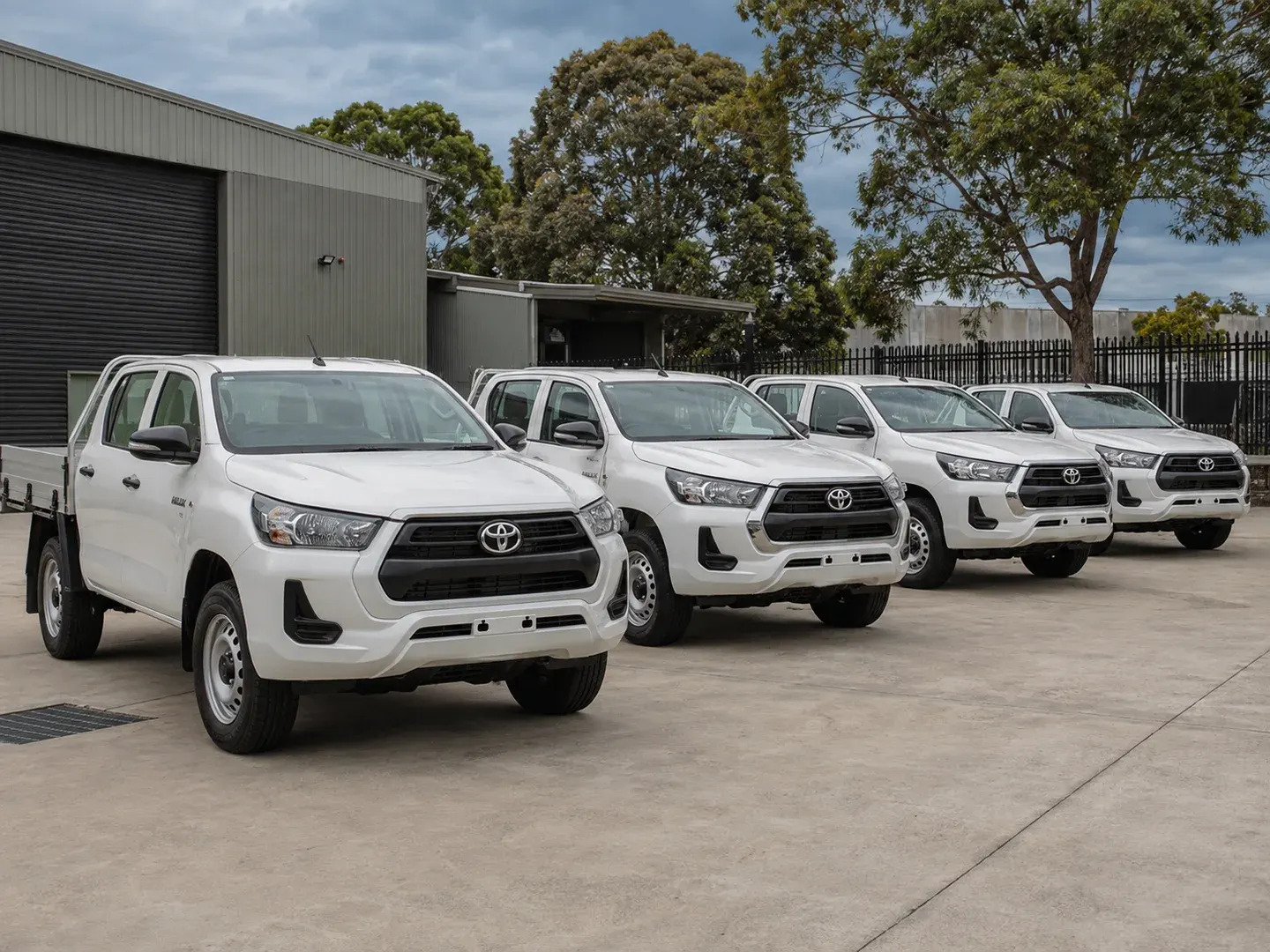 Business fleet finance · Western Sydney, NSW
All four approved first go under one facility and settled within five business days at 8.69%. No deposit, and a 30% balloon kept cash free for the project.
Stock photo.
Want a result like this? Let’s get you started.
Price my fleetPlan on one to two weeks from the day the lender has your full financials. It's a full credit assessment, done once.
Two years of accountant-prepared financials, your current asset and loan list, and what you plan to buy over the next 12 months.
The lender tests your profit against repayments on the whole limit. We size the request to your buying plan so it gets approved.
The invoice goes to the lender with a short drawdown schedule. The lender confirms the asset is on its list, sets the rate for that day and pays the supplier. No new credit application.
The lender re-reviews your banking and financials and renews the limit for another year, or lifts it if the business has grown.
Tell us how many vehicles, when you need them and how often you replace them. We’ll go after one facility that covers the lot.
A chattel mortgage limit if you want to own the assets, which is most businesses. A master lease or rental agreement if you'd rather hand them back or upgrade at the end.
A pre-approved limit where each drawdown is a chattel mortgage. Your business owns the asset from the day it's drawn and the lender takes security over it.
One master agreement, then a lease schedule for each asset. The lender owns the asset and you pay rentals, with a residual at the end. One master lease on our panel runs for 12 months of drawdowns and covers equipment only.
A rental version built for businesses that turn assets over. Drawdowns across several asset types sit under one pre-approved limit.
No. Once you draw $200,000 of a $1 million limit, you have $800,000 left, and paying down the first drawdown doesn't top the limit back up. Each drawdown is its own fixed loan with its own term and repayment.
The reset happens at the yearly review. The lender looks at your banking and financials again and sets the limit for the next 12 months, bigger if the business has grown.
Yes. Every drawdown is a separate contract, and the lender charges its establishment fee on each one, usually around $500 to $650. One bank on our panel charges a lower document fee on a drawdown under a master agreement than on a standalone loan.
Budget for it when you plan the buying. Ten utes drawn as one batch is one set of paperwork. Ten utes drawn one at a time is ten.
Yes, as long as each asset is on the lender's accepted list. Utes, vans, trucks, trailers and yellow goods sit under one limit with most facility lenders, and fleet limits are written on prime movers too.
Where one asset suits a different lender, we run it as a standalone loan beside the facility so nothing holds up the rest.
That's what the limit is for. The approval sits there for 12 months, so a vehicle landing in March and another in August are two drawdowns on the same approval. Give us the delivery dates up front and each drawdown is ready when the vehicle is.
More than most people expect. Without a limit, lenders cap what they'll lend you on low doc, and the cap lifts as you repay: commonly $250,000 as a new customer, $500,000 after 12 months of clean repayments and $750,000 after 2 to 5 years.
That's the path for a growing business. Finance what you need now, build the history, and move to a master limit when the buying gets regular.
No. Each drawdown gets its own term and balloon. A ute doing 60,000 kilometres a year needs a shorter term than a trailer that will last 20 years. On a 5 year term we recommend a 30% balloon on vehicles you'll turn over, and none on anything you're keeping.
Stagger the terms. Vehicles doing different kilometres wear out at different speeds, so set each term to the month you plan to replace that vehicle. Four utes on 36, 48, 48 and 60 months means one changeover at a time instead of four balloons due together.
The payout on the old vehicle is cleared at settlement of the new one, and any trade-in equity comes off the amount you draw. Get a dated payout letter for each vehicle before you order its replacement.
Let’s find the best fleet finance for you.
Get my free quoteSet up a limit when you'll buy $500,000 or more of assets over the next 12 months and have the financials to back it. Below that, finance what you need now and let your lending limit build.
You're buying vehicles or equipment every few months, not once a year.
You want the money approved before you find the asset, so you can move on a good one the same week.
You want one credit assessment a year instead of an enquiry on your file for every purchase.
Your fleet is growing and you want a limit that grows with it.
The company is under 2 years old or has no accountant-prepared financials yet.
You're buying a handful of vehicles now and nothing after that.
You won't use most of the limit: each drawdown still pays its own establishment fee, so a limit you don't draw saves you nothing.
Corey has been exceptional to deal with. He responded quickly, listened carefully to our needs and took the time to understand our situation. His support and clear communication made a stressful process much easier. This has been the best service I’ve received from a finance broker, and I’d happily recommend Corey and X Lend.
I can’t speak highly enough of Corey and his work. I explained what I needed and he went above and beyond to secure me a personal loan that I needed. It was a debt reconsolidation which paid out my old high interest loans and set me up with a loan paying half of what I was and some extra cash right before Xmas. 10/10
I had a great experience working with Corey and couldn’t recommend him highly enough. He went above and beyond to help me throughout the process, providing valuable guidance and advice on how to improve my chances of approval. Corey is extremely knowledgeable, experienced, efficient and his communication was excellent from start to finish. He kept me informed at every stage, always approachable and was never difficult to get in touch with whenever I had questions.
You’re next. Let’s get
your fleet finance approved.
No. A master limit needs the full financials of the business: 2 years, accountant-prepared, plus security over every asset. Low doc still works for a few vehicles at a time, and lenders commonly take a repeat customer to $750,000 of low doc lending as the repayment history builds.
Yes. Commercial lenders take a guarantee from every director, and some from major shareholders as well. The guarantee sits beside the lender's security over each asset.
No. The assets you buy are the security. Owning property still helps: it's the first thing a lender looks for when it decides how big a limit to give you and whether to ask for a deposit.
Nothing. You pay interest only on what you've drawn, and the unused part lapses or renews at the 12 month review. That's what happened with the $1.5 million limit we had pre-approved for a developer.
Usually not. Property owners are asked for no deposit nine times out of ten. Renters are asked for nil, 10% or 20%, depending on the lender.
Cars, utes and vans to about 12 to 20 years old at the end of the term with most lenders, and trucks, trailers and yellow goods to about 30. A facility is mostly used for new and near-new assets, where the rate is sharpest.
Most of our deals carry a broker fee, and the lender pays us a commission as well. Both are in your quote before you sign anything.
No, we're the broker. We take your financials to the lenders on our panel of 80+ that write master limits, and come back with the limit, the rate basis and the fees side by side.
No. As an authorised access seeker we read your credit file without touching your score, then match you to the right lender before anything is lodged. The lender only runs its own check once you say go.
Equifax: soft and hard credit checks · OAIC: credit reporting terms

Reviewed by Corey Marino
FBAA member M-354085 · Diploma-qualified finance broker · X Lend Finance Pty Ltd, Credit Representative 551197 of AFAS Group (ACL 414426) · Last reviewed 20 November 2026 · Content updated