
80+ lenders, one application
We compare commercial and asset lenders in one go to match your plant to the sharpest available rate.
Turn your next opportunity into working capacity. We’ll explore our 80+ lender panel for suitable machinery finance and explain the structure and costs.

If it makes, shapes or packs your product, we can usually finance it. We arrange finance for:
CNC machines, lathes and mills
Presses, brakes and metal forming plant
Injection moulders and plastics machinery
Packaging, filling and labelling lines
Processing and production lines
Woodworking and joinery machinery
Used, ex plant and imported machines
Compressors, generators and ancillary plant
These machinery examples are not a restricted list. A lender will usually place more weight on the chosen asset's age, condition, specification and intended work than its badge.
The way this machinery is being purchased affects the lender's valuation, available term and security checks.
These records connect the machinery, its total cost and intended work with the business's ability to make the repayments.
Have something in mind? Let’s talk finance.
Get my free quoteProduction machinery is the asset that turns raw material into revenue, and it shouldn't tie up the capital you need to buy stock, hold inventory and meet payroll. X Lend is a finance broker: we take one application and compare it across 80+ banks and nonbank lenders to fund the plant and keep your working capital producing.
We compare commercial and asset lenders in one go to match your plant to the sharpest available rate.
We place used, imported and niche machinery with lenders whose asset policy accommodates it.
Established manufacturers can often finance significant plant without full financials.
We arrange finance for CNC machines, lathes and mills, presses, injection moulders, packaging and processing lines, and general industrial plant, new, used or imported, single machines or a full line upgrade. We structure it as a chattel mortgage, hire purchase or rental to suit your GST, depreciation and accountant's advice.
Because we shop the whole panel, we can place specialised and used machinery that a single bank might decline, work with import and progress payment timelines, and match low doc options to how your business actually trades. We keep it plain English and only submit once you're ready.
We can structure facilities around import timelines and staged payments for machines built to order.
For plant and machinery, compare chattel mortgage, hire purchase and rental against the asset's useful life and the business's accountant-confirmed tax position.
Many plant deals settle in 48 to 72 hours so the machine is producing sooner.
Specialised or imported machinery that one bank won't touch often finds a home across a panel of 80+ lenders. Established ABNs can frequently access low doc approvals on trading history, and progress payment arrangements can be structured for machines built or shipped to order.
Try an amount and term for your machinery finance. When you’re ready, we’ll compare the options available to you.
Adjust the amount, term and rate to see an indicative repayment.
Estimate only. Calculations include an assumed $990 broker origination fee and $500 lender fee, both financed. Total repayable includes those fees, interest and any final balloon. Weekly and fortnightly figures are equivalents of the monthly estimate. Actual fees and repayment timing depend on your offer.
Your quote takes your circumstances and finance requirements into account. Compare your rate, fees and repayments together before choosing an offer.
Find my optionsThe fabricator wanted to bring smaller cutting jobs in-house, but the selected machine was used and specialised, requiring more asset evidence than standard equipment.
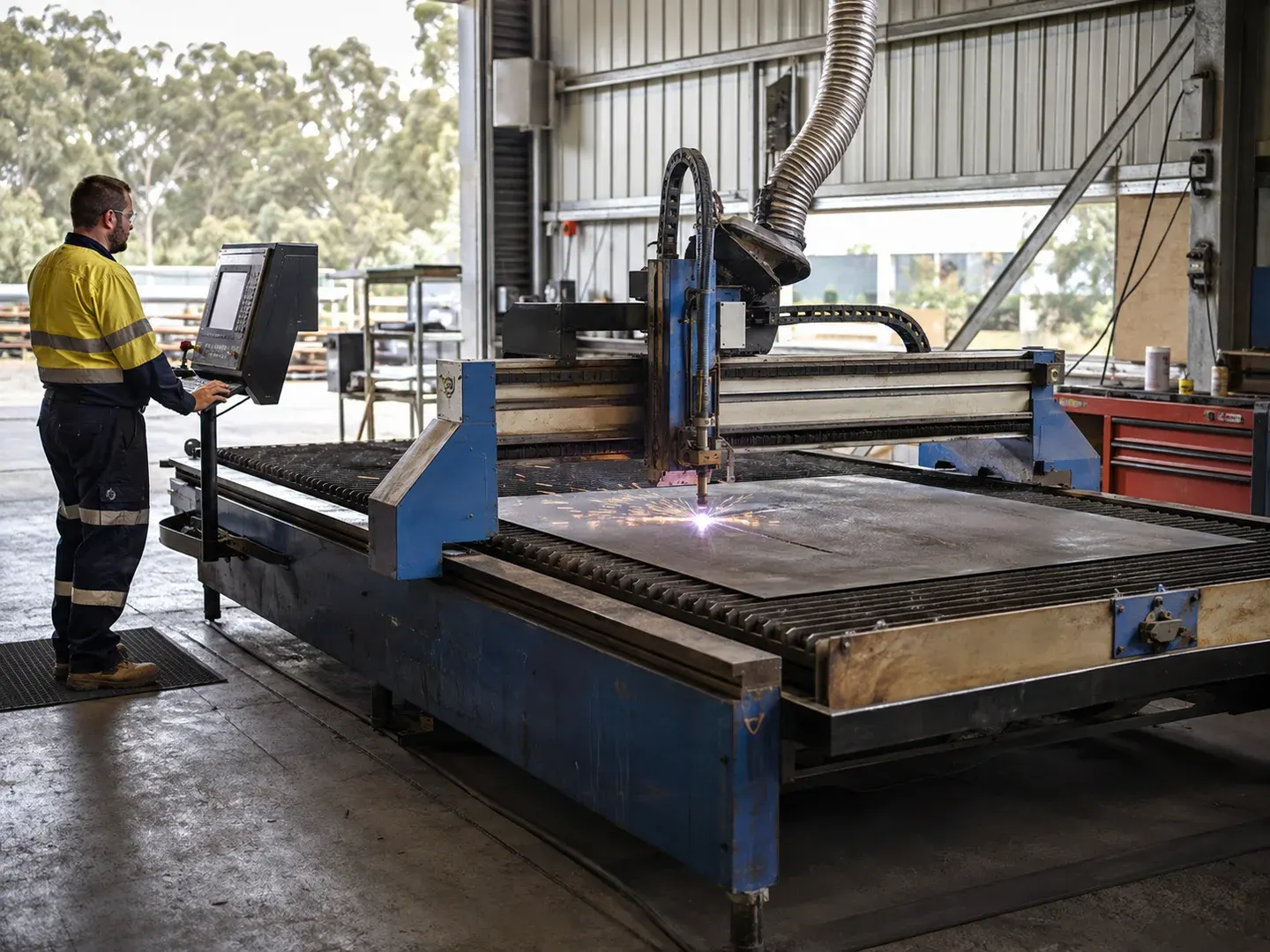 Manufacturing equipment finance · Dandenong, VIC
Approved on the first lender enquiry and settled at a historical rate of 11.1%. The machine was installed and smaller cutting jobs moved in-house.
Historical customer outcome. Vehicle and business images are illustrative.
Find out what’s possible for you.
Get my free quoteWe match your circumstances to suitable lenders for machinery finance. Your broker helps you prepare the application.
A lender wants to know what the machinery is, what it will do for the business, how long it should remain useful and whether the repayments are affordable. The details below explain the usual checks and what can help support the application.
Your broker handles the lender comparison and paperwork for machinery finance, keeping you informed at each step.
Tell us what you want to finance, how much you need and when you need it. That could include CNC machines, lathes and mills.
We help organise technical specification and supplier quote and check the lender criteria that apply to your circumstances to find lenders that fit your situation.
We explain the available rate, term, repayment and security options, including the full cost and how repayments fit your budget. You choose the option to take forward.
Your broker coordinates lender conditions, signed documents and payment details, so you can focus on what comes next.
Your broker reviews your enquiry and explains the next steps, usually within one business day. An enquiry does not create a credit check or an obligation to proceed.
Compare the ways you can arrange machinery finance, with a broker to explain your options.
Swipe across the table to compare all columns.
| Your situation | Option to consider | What to compare |
|---|---|---|
| A short project or uncertain workload | Hire for the project | Hire charges, delivery, minimum periods and availability against owning a machine between jobs. |
| Regular work for the same machine | Ownership with cash or finance | Repayments, deposit, maintenance, insurance, transport, downtime and likely resale value. |
| Regular work with occasional specialist jobs | Own the core machine; hire specialist equipment | The utilisation of each machine separately, including attachments and seasonal demand. |
Repayments continue between jobs. Hiring may preserve flexibility, while ownership brings maintenance and resale responsibilities. Compare written quotes using the same workload and period.
Swipe across the table to compare all columns.
| Check | Evidence to gather | Why it matters |
|---|---|---|
| Make and model | Exact model, serial number, year, hours and attachment details | Lets the broker ask about the actual machine instead of relying on a blanket brand rule. |
| Parts and service support | Local service options, parts lead times, warranty and maintenance history | Helps estimate downtime and the cash needed to keep the machine working. |
| Condition and resale | Independent inspection and comparable equipment listings or a valuation | Purchase price, condition and assessed value can differ. A lender may require more evidence or a contribution. |
| Auction or private sale | Seller identity, invoice, ownership and any finance payout details | Resolve lender acceptance and payment deadlines before making an unconditional commitment. |
Asset age and finance terms · Buying equipment at auction · PPSR and settlement checks
Swipe across the table to compare all columns.
| Option | During the loan | At the end |
|---|---|---|
| No balloon | Higher regular repayments than the same loan with a balloon; the balance reduces faster | The scheduled loan balance is repaid when all payments have been made. |
| A balloon payment | Lower regular repayments, but interest is charged on a larger outstanding balance | A lump sum remains due. Budget for it rather than assuming resale or refinancing will cover it. |
| A shorter term | Higher regular repayments may reduce total interest on otherwise equal terms | Check affordability alongside the total amount repaid, fees and any payout costs. |
Use the calculator to compare the same amount, rate and term with and without a balloon. Refinancing requires a new assessment and is not guaranteed.
A strong application connects the asset to production capacity, cost savings, contracts or replacement needs and gives the lender enough information to understand its value.
CNC equipment, processing lines and custom plant can require valuations, specifications or a stronger business assessment because resale is less straightforward.
Freight, commissioning, software and building works may not all be financeable under the same asset facility. Itemise them early.
Currency, supplier verification, shipping, duties and staged payments can alter the structure and settlement process.
A longer term may lower scheduled repayments but should remain sensible relative to expected operating life and obsolescence.
| Structure | How it generally works | Important consideration |
|---|---|---|
| Chattel mortgage | The business owns the asset while the lender takes security over it. | Tax and GST treatment depends on the business; obtain accounting advice. |
| Finance lease | The lender owns the asset and the business pays to use it for the agreed term. | End-of-term options, residual value and total cost should be checked. |
| Rental or operating lease | The business pays for use and may receive bundled service options while the provider retains ownership. | Flexibility can be useful, and the complete cost and return conditions still matter. |
A lender may be familiar with a standard lathe or packaging line but need more context for custom plant. Provide the manufacturer, model, serial number, year, specification, country of origin, warranty and local service arrangements. Explain what the machine produces, its expected throughput and whether it can be resold or repurposed outside the current business.
For a production line, separate each major component and identify whether the items can operate independently. Control systems, tooling, software licences and consumables may not carry the same security value as the physical machine. A detailed quote avoids a single project total hiding costs that require different funding treatment.
Imported or made-to-order machinery can involve deposits, progress payments, foreign currency, shipping, duties, commissioning and acceptance testing. A normal asset lender may not fund every stage before the machine exists in Australia. The purchase contract and payment timetable should therefore be reviewed before the business commits to the supplier.
Allow for delays between payment and productive use. Rent, wages and existing debt continue while a machine is shipped and commissioned. A separate cash-flow allowance may be required for training, raw materials and the first production cycle. Finance approval does not verify the supplier, technical suitability or import compliance, so independent commercial and technical checks remain important.
Compare the proposed repayment with current outsourcing costs, demonstrated demand, labour savings and achievable production volume. Use conservative assumptions for sale price, scrap, downtime and ramp-up. If the purchase is justified by one customer, consider what happens if that volume is delayed or the contract ends early.
The term should reflect both mechanical life and technological relevance. A well-maintained machine may operate for many years but become commercially obsolete sooner. Check early payout and upgrade options if the business expects technology, customer specifications or regulation to change during the proposed facility.
Operating hours, cycle counts, maintenance records, software generation, tooling and manufacturer support influence the useful life of industrial machinery. In practical terms, this can change the deposit required, how long the loan can run and which lenders will consider the asset.
Maintenance and replacement spending maintains throughput and reliability, while expansion machinery should be supported by demand evidence and a commissioning plan. These costs need to fit beside the repayments. The loan should also finish within the period the asset is expected to remain useful to the business.
Customer orders, production schedules and capacity constraints can explain the commercial reason for the machine and the timing of staged supplier payments. Contracts, purchase orders and confirmed work can help show how the asset is expected to earn money and when customers are expected to pay.
If the machinery supplier needs a deposit, progress payments and a final payment, list each date and amount. This lets the lender reconcile the full purchase cost and arrange the payment stages correctly.
Illustrative examples of how we approach machinery finance.
The business has a shorter ABN history and confirmed work that requires the machinery.
We identify lenders that can assess recent account history, industry experience and contracted work, then present the purchase as one complete operating proposal.
Business bank statements, GST registration, signed work agreements, the supplier quote and evidence of the operator's experience.
The chosen asset has material age, hours or kilometres and remains suitable for the work ahead.
We document condition, service history, specification and resale support, then compare lenders whose end-of-term age policy fits the proposed term.
Service records, inspection details, serial or VIN information, photographs, the invoice and a clear explanation of expected annual use.
Current work supports the purchase while the latest full-year accounts are still being prepared.
We list the documents already available, current debts and expected payment timing, then compare lenders that accept that evidence.
Recent bank statements, BAS, management accounts, an accountant letter, contracts, purchase orders and a schedule of existing finance.
Specialised machinery needs a lender-ready description. We separate the physical machine from installation, software and working-capital costs, then explain the productive use and service support so a lender can assess the complete project and understand every invoice component.
Let’s compare your options.
Get my free quoteSee how arranging finance compares with waiting or paying the full cost upfront.
Put the piece of machinery needed for suitable work into service without waiting to fund the full cost from cash.
Preserve working capital for wages, materials and tax while arranging the piece of machinery.
Replace an unreliable or unsuitable piece of machinery before downtime and repair costs increase.
Suitable contracts may be missed when the required piece of machinery is not available.
An older piece of machinery can keep creating downtime or repair costs while its replacement is delayed.
Buying the piece of machinery outright can reduce the cash buffer available for payroll, materials and unexpected costs.
Corey was excellent to deal with. He was able to get me a better rate than everyone else, he was very responsive, worked quickly and made the process very easy, even with me asking a million questions. I would definitely use him again next time.
I can’t recommend Corey from X Lend highly enough. From the very first conversation, he was professional, transparent, and genuinely focused on finding the best outcome for me. Corey took the time to explain every step of the finance process in a way that was easy to understand, answered all my questions promptly, and never once made me feel rushed or pressured. I really appreciated how proactive he was, keeping me updated, following up with lenders, and making sure everything stayed on track. What really stood out was how hard he worked to secure a great deal. He compared multiple lenders, negotiated on my behalf, and ultimately achieved a rate and repayment structure that exceeded my expectations. The whole process of purchasing my car was smooth and stress‑free thanks to their expertise. If you’re looking for someone knowledgeable, reliable, and genuinely in your corner, I wouldn’t hesitate to recommend them. I’ll definitely be using their services again in the future :)
Corey helped me through the entire process of getting my dream family car! He was extremely prompt with his responses and had everything organised quickly and smoothly. I made a huge mistake by settling finance on the wrong car (a 5‑seater instead of a 7‑seater), but Corey was incredibly understanding and supportive. He contacted the dealership, lender, and even rearranged my insurance for me. He did all of this without ever making me feel like a hassle, even though I knew I was being a pain! Despite the setback, Corey stayed fast and efficient, kept me confident throughout the process, and managed to get everything cancelled and re‑approved for a higher amount so I could get my actual dream car. I highly recommend Corey. He speaks to you like a friend and genuinely has your best interests at heart. I already had quotes from Toyota Finance and Toyota Insurance, and Corey was able to get both significantly cheaper. Toyota Finance even reviewed Corey’s figures and confirmed they couldn’t beat them. I will never look to another finance company again.
Let us help with
machinery finance.
The details you want to know before taking the next step.
We're a finance broker: we compare 80+ banks and nonbank lenders and place your machinery finance with the best fit for your business.
Usually, yes. Many of our lenders fund used, ex plant and imported machines. We match the machine's age, type and origin to lenders comfortable funding it.
Often, yes. For machines built or shipped to order, we can arrange facilities that align with staged and progress payments. We'll explain how the timing works before you commit.
Often, yes. Established ABNs can frequently access low doc options up to set limits on trading history alone. We match you to lenders comfortable with your industry.
Many machinery deals get a same day decision and settle within 48 to 72 hours once documents are in.
Common examples include Haas, Mazak, Okuma, DMG Mori, Trumpf, Bystronic. This is not a restricted list: the lender will still look at the exact item or purpose, the amount requested and your circumstances.
A lender may ask for technical specification, supplier quote, production forecast, existing order book, service agreement, bank statements. You may not need everything on that list. X Lend confirms what applies before anything is submitted.
For machinery finance, we first confirm the transaction, timing and available evidence. We then explain the issues that matter, compare lenders whose rules fit those facts and show the proposed option before any application is submitted.

Reviewed by Corey Marino
FBAA member M-354085 · Diploma-qualified finance broker · Last reviewed 24 August 2026