
Do I need a deposit?
Usually not. Property owners are asked for no deposit nine times out of ten. If you rent, it's nil, 10% or 20% depending on the lender. Our GLE deal went in with a $20,000 deposit.
Low salary on paper, strong company behind you. We had a $118,000 Mercedes-Benz GLE approved on the company’s numbers at 7.59%, by the first lender, and settled in 3 business days. Company name or yours, FBT, the car limit and luxury car tax are all answered below.

Yes. In May 2026 the director of a six-year-old company wanted a $118,000 Mercedes-Benz GLE. Their personal taxable income looked low, because the profit stayed in the company and came out as distributions. A lender reading only the salary would have said no. We set it up as commercial vehicle finance with a bank that assessed the company's trading instead: approved by the first lender at 7.59% over 60 months, with a $20,000 deposit and a 30% balloon, and settled in 3 business days.
Usually not. Property owners are asked for no deposit nine times out of ten. If you rent, it's nil, 10% or 20% depending on the lender. Our GLE deal went in with a $20,000 deposit.
On low doc most lenders stop at about $150,000 for a car, and around $250,000 for a company with property behind it and a long ABN. Past that it's full company financials, which is also where the sharpest rate is.
Our GLE settled in 3 business days on full financials. A low doc approval usually comes back in about 6 hours, with the documents the next day.
Decide whose name the car goes in before the dealer writes the invoice. The invoice, the loan and the rego all have to show the same buyer, and changing it afterwards means starting again.
Tell us the car and whose name it's going in. We'll build the application on whichever set of numbers is stronger.
Company buys: the lender reads the company's accounts and takes a director guarantee. You buy: the lender reads the income paid to you.
| What to compare | Company buys the car | Director buys personally |
|---|---|---|
| Who signs | The company borrows and the directors guarantee it. | You borrow in your own name. |
| Income the lender reads | Company financials, cash flow and business debts. | Salary and distributions paid to you, and your personal debts. |
| Documents | Company financials, tax returns and business bank statements, or low doc for an established ABN. | Payslips, your tax return or a letter from the company's accountant. |
| Tax to check first | Fringe benefits tax on your private use. The $69,883 car limit on what the company can claim. | How you claim business trips in your own return. |
| Name on the invoice and rego | The company. | You. |
Prestige, executive and everyday cars, new or used, from a dealer or a private seller, bought by the company, a trust or you personally.
Prestige and luxury sedans
Executive and luxury SUVs
European and performance cars
Electric cars
Dual cab utes used by a director
New, demo and used cars
Dealer and private sale purchases
Refinancing an existing car loan
About $1,595 a month on $100,000 over 5 years at 7.59% with a 30% balloon ($30,000), before fees. With no balloon it's about $2,008 a month.
Change the amount, the term and the rate to see your repayment.
Includes our usual $990 broker fee added to the loan. Your own rate comes with your quote.
7.59% on a settled deal. That's what the Mercedes-Benz GLE settled at with a bank: full company financials, six years of trading, an 820 credit score and a director who owns property. That's the profile that gets the best rate.
A newer car, a longer ABN and full financials each pull the rate down. Low doc, renting and a private sale each push it up, by about 0.5 to 2 points apiece depending on the lender.
Fees: the lender's establishment fee is usually $500 to $650, and most of our deals carry a broker fee. Both are in your quote before you sign.
Find my rateThe director of any company or trust with an ABN, buying a car that's used in the business. Banks want 2 years of trading. Non-bank lenders take about 1 year of GST registration, and a company with full financials and a property-owning director gets the widest choice.
Four things, and each has a fix. A lender that reads only your salary when the profit sits in the company: we go to one that assesses the company. An invoice in your name with the loan in the company's: get the name right before the dealer writes it. A price over the lender's cap: one of our lenders stops at $100,000 on a passenger car and another wants full financials above that figure, so a dearer car goes elsewhere. And a balloon bigger than the lender allows for that car's age: 30% is the safe number on 5 years.
Yes, with an established ABN and the car used in the business. Banks want 2 years of ABN and GST registration and non-bank lenders about 1 year of GST. If you have full company financials, use them: that's how our GLE director got 7.59%.
Around 700 or better for the sharpest rates. Our GLE director had 820 and owned property, and got 7.59%. You can be approved lower: several commercial lenders start at 500 to 550 on the director. One of our lenders scores the company instead of the director, which helps when the business file is cleaner than yours.
A low personal income on paper. A $118,000 Mercedes GLE at 7.59%. The director's personal taxable income looked low because the profits stayed in the company and came out as distributions. A salary-only assessment would have undersold them badly.
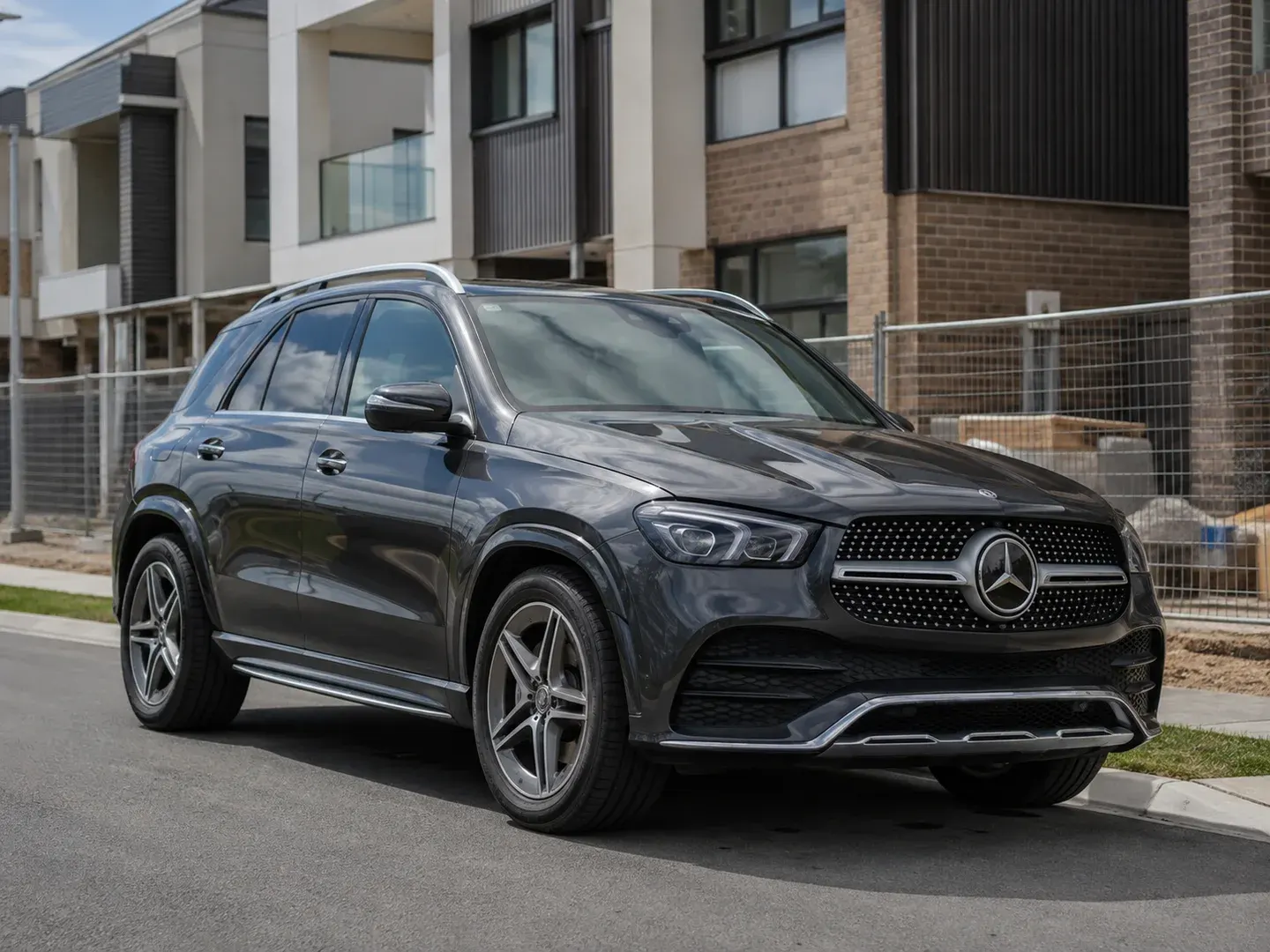 Director vehicle finance · Sydney, NSW
Approved first go and settled in three business days at 7.59%, with a 30% balloon keeping the monthly repayment down.
Stock photo.
Want a result like this? Let’s get you started.
Get my director’s car approvedA chattel mortgage if the company wants to own the car, which is what most directors choose. A finance lease if you'd rather hand it back every few years. Which one is better for your tax is your accountant's call, and we finance it whichever way they pick.
When the company wants to own the car from day one. It claims the GST up front (capped at $6,353 on a car), then depreciation up to the car limit and the interest.
When you change cars on a set cycle. The lender owns the car and the company pays rentals, with a residual at the end to keep it or hand it back.
That's salary packaging: the company pays the lease out of your pre-tax pay. We don't write novated leases. Get the provider's full breakdown, every fee included, and put it beside our quote. Nine times out of ten ours comes out cheaper.
Yes. Every commercial lender we use takes a guarantee from the directors on a company car loan, and one of ours wants it from any shareholder with more than 40%. It means you're personally responsible if the company can't pay. It isn't a mortgage over your home.
No, and you don't need to. A loan in your name is assessed on the salary and distributions actually paid to you. If that figure is low because you leave profit in the company, put the loan in the company's name and let its numbers do the work.
Yes. The trustee borrows, and the lender asks for the trust deed along with the financials. Where the trustee is a company, its directors give the guarantee. One thing to plan for: with some lenders, property held in the business or trust name doesn't count as property backing. It has to be in the guarantor's own name.
30% on a 5 year term if you change cars every few years. On a brand new car over 36 months or less, lenders go as high as 50%, and it's easiest when the director owns property.
Keeping the car longer than the term? Go without. A balloon on a car you're not selling is a lump sum you have to find or refinance.
Let’s find the best director’s car loan for you.
Get my free quoteFour steps. Our GLE went from first lender to settled in 3 business days.
The company, a trust or you. Send us the buyer, the car and how it'll be used.
Company financials and bank statements for a company borrower. Salary and distributions for a personal borrower.
You get the rate, fees, repayment, balloon and the guarantee in writing before an application goes in.
As soon as the documents are signed and the invoice, rego and any payout are in order. Then the keys are yours.
Tell us the car and whose name it’s going in. We’ll back the application with the company’s numbers, not just your salary.
When the company is doing well and your payslip doesn't show it. The company's numbers get the approval and the rate that your personal tax return can't.
The company trades strongly and keeps most of its profit in the business.
The car is used mainly for work, and a logbook will show it.
You change cars every 3 to 5 years and want a balloon to match.
The car is mainly for private use: FBT at 47% can cost more than the company's deductions save.
Your own salary covers the loan comfortably: a personal car loan is simpler.
The company is under a year old and you have a strong personal file.
Corey has been exceptional to deal with. He responded quickly, listened carefully to our needs and took the time to understand our situation. His support and clear communication made a stressful process much easier. This has been the best service I’ve received from a finance broker, and I’d happily recommend Corey and X Lend.
I can’t speak highly enough of Corey and his work. I explained what I needed and he went above and beyond to secure me a personal loan that I needed. It was a debt reconsolidation which paid out my old high interest loans and set me up with a loan paying half of what I was and some extra cash right before Xmas. 10/10
I had a great experience working with Corey and couldn’t recommend him highly enough. He went above and beyond to help me throughout the process, providing valuable guidance and advice on how to improve my chances of approval. Corey is extremely knowledgeable, experienced, efficient and his communication was excellent from start to finish. He kept me informed at every stage, always approachable and was never difficult to get in touch with whenever I had questions.
You’re next. Let’s get
your director’s car loan approved.
When the company owns or leases the car and it's available for your private use. For FBT a director counts as an employee, and a car garaged at your home counts as available for private use even on days you don't drive it. The rate is 47% for the FBT years ending 31 March 2023 to 2027.
Under the statutory method, the taxable value is a flat 20% of the car's price, however far you drive it. Here's an example: on a $100,000 car that's $20,000, grossed up by 2.0802 and taxed at 47%, which is about $19,554 a year. The other method uses a logbook kept for 12 weeks. If the logbook shows 80% business use and the car costs $25,000 a year to run, the taxable value drops to $5,000 and the FBT to about $4,888. The company can use whichever method gives the lower figure each year.
Not automatically. The ute has to be built to carry a tonne or more, or not mainly to carry passengers, and your private use has to be minor, infrequent and irregular. Driving to and from work is fine. Weekends away and the school run are not.
Yes, when it's a zero or low emissions car first held and used on or after 1 July 2022 and luxury car tax has never been payable on it. Plug-in hybrids stopped qualifying on 1 April 2025 unless a binding commitment was already in place. The exempt car's value still counts toward your reportable fringe benefits.
$69,883. That's the most a business can depreciate on a car first used in 2026-27, however much it paid, and the GST credit is capped at one eleventh of it: $6,353. Buy a $120,000 car and the company still claims GST and depreciation as if it cost $69,883. The limit doesn't stop you financing the full price.
When the car's price is over $80,809 in 2026-27, or over $91,661 for a fuel-efficient car. The tax is 33% of the amount above the threshold, worked out on the price before GST. Here's an example: a $120,000 car is $39,191 over the line, and the tax comes to about $11,757. It's already in the dealer's drive-away price, and the loan covers it.
Yes. On a private sale we run the PPSR check and the lender pays out any finance the seller still owes before the seller gets a dollar. Some lenders cap a private sale at $100,000 to $150,000, so a dearer car goes to a lender with a $250,000 cap.
Up to about 25 years old at the end of the loan with our lenders, and we have specialist lenders with no age limit for a classic. The sharpest rates and the biggest balloons are for cars under 3 years old.
Most of our deals carry a broker fee, and the lender pays us a commission as well. Both are in your quote before you sign anything.
No. As an authorised access seeker we read your credit file without touching your score, then match you to the right lender before anything is lodged. The lender only runs its own check once you say go.
Equifax: soft and hard credit checks · OAIC: credit reporting terms

Reviewed by Corey Marino
FBAA member M-354085 · Diploma-qualified finance broker · X Lend Finance Pty Ltd, Credit Representative 551197 of AFAS Group (ACL 414426) · Last reviewed 20 November 2026 · Content updated